
For years, I was the “Yes Man” of freelancing. A client would ask if I could build a website, manage their SEO, and walk their neurotic labradoodle, and I’d enthusiastically agree. I was basically a digital circus clown, juggling sixteen different tasks for twelve different clients, all while my hourly rate plummeted toward minimum wage. I was exhausted, broke, and one “quick revision” away from a mental breakdown. Then I discovered productized services. I realized that if I stopped trying to be everything to everyone and started selling one specific result like a pre-packaged box of cereal, I could actually sleep at night. Now, I don’t sell “hours”; I sell “outcomes,” and my labradoodle-walking days are officially over.
1. The “Custom Project” Death Spiral:
The biggest lie I ever told myself was that “Customization” was my competitive advantage. I thought that by offering bespoke solutions to every client, I was providing a premium experience. In reality, I was just reinventing the wheel every Monday morning.
When you sell custom services, you are trapped in the Proposal-to-Prison Pipeline. You spend ten hours writing a detailed pitch, negotiating the scope, and trying to guess how much time the work will actually take. Then, the “Scope Creep” sets in. The client wants “one more tiny change,” and suddenly your $2,000 project is paying you $4.50 an hour.
Productizing is the act of turning your service into a Fixed-Scope Product.
- The Old Way: “I’ll write some blog posts for you. Let’s talk about a monthly retainer.”
- The Productized Way: “I will deliver four 1,500-word SEO-optimized blog posts with custom graphics for $1,200. Delivery in 7 days.”
By removing the “Grey Areas,” you remove the friction. The client knows exactly what they are getting, and you know exactly how long it will take. This is how you reclaim your time and your sanity.
2. Finding Your “Value Anchor.”
You can’t productize everything. If your service requires twenty hours of deep strategic consulting before you can even start, it’s hard to put it in a box. To Make Money Online with this model, you need to find the “Repeatable High-Value Task.”
I call this the Value Anchor. It’s the one thing you do that provides a massive, measurable result for the client but follows a predictable process for you.
For me, it was “Landing Page Optimization.” Instead of offering “Digital Marketing,” I offered a “Conversion Audit.” I had a 25-point checklist I ran on every page. Because I had done it a hundred times, I could do the audit in two hours. To the client, that audit was worth $500 because it could potentially double their sales. To me, it was $250 an hour. That is the magic of the productized model: The client pays for the result, not the clock.
3. The “Standard Operating Procedure” (SOP) is Your Real Product:
If you are the only person who can do the work, you don’t have a productized service; you just have a very organized job. The goal of productizing is to build a System that can eventually run without you.
I spent three months documenting every single click, thought, and email involved in my “Landing Page Audit.” I turned it into a massive SOP.
- Step 1: Intake form via Typeform.
- Step 2: Automated Slack notification.
- Step 3: Run the 25-point audit (with Loom video instructions).
- Step 4: Send the PDF report via a templated email.
Once I had this system, I could hire a junior specialist to do 80% of the work. My “work” became quality control and growth. If you can’t write down exactly how your service works in a way that someone else could follow, it’s not a product yet. You are selling your “Genius,” and genius is notoriously hard to scale.
4. Pricing for Profit, Not for Competition:
One of the most common mistakes I see in the Making Money Online niche is people racing to the bottom on price. They look at what some guy on Fiverr is charging and try to match it.
In a productized service, your pricing should be based on The Cost of the Problem. If a company is losing $5,000 a month because their checkout page is confusing, a $1,000 “Checkout Optimization Package” is a bargain. It doesn’t matter if it takes you five minutes or five hours.
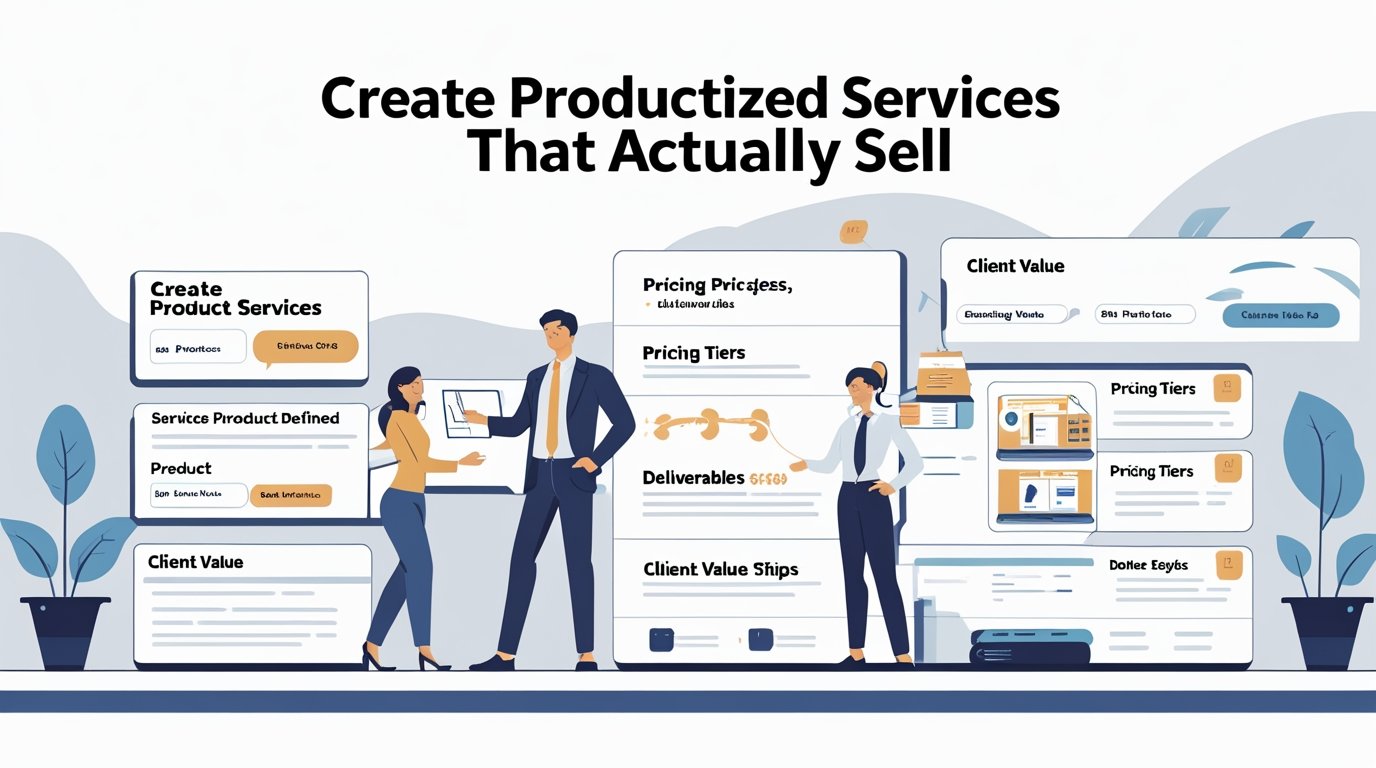
I learned to offer three tiers:
- The Entry Level: A small, “Foot in the Door” product (e.g., A single audit).
- The Sweet Spot: The main service (e.g., A full optimization sprint).
- The “Done-For-You” Monthly: A recurring version for ongoing value.
By having fixed prices, you eliminate the “Price Negotiation” dance. If they can’t afford the $1,000 package, they can buy the $200 audit. If they want more, they can upgrade. You stop being a “Salesperson” and start being a “Solution Provider.”
5. The Power of the “Intake Form.”
My life changed when I stopped doing “Discovery Calls.” I realized that 90% of those calls were a waste of time, either the client wasn’t a fit, or I was repeating the same information over and over.
A true productized service uses a Rigid Intake Process. Before I even look at a client’s project, they have to fill out a detailed form and, in many cases, pay upfront. This acts as a “B.S. Filter.” People who aren’t serious won’t fill out a 15-question form. People who are “window shopping” won’t pay a $500 deposit.
This filters for the “Ideal Client”, the one who knows what they want and respects your process. I found that my “Work Satisfaction” tripled when I stopped trying to convince people to hire me and started letting my intake system do the heavy lifting.
6. Creating a “Niche Monopoly.”
To really win at productized services, you need to go “Deep” rather than “Wide.” “I do Facebook Ads” is a commodity service. “I do Facebook Ad Creative for High-End Orthodontists” is a productized service.
When you specialize that heavily, you become a Niche Monopoly. You know exactly which headlines work for orthodontists. You know the “Before and After” regulations for dental ads. You have a “Library” of successful templates.
This specialization allows you to deliver better results in less time. You aren’t learning a new industry every week. You are just applying your proven “Product” to a new customer in a familiar field. I’ve seen people make six figures a year just doing “Email Automation for Shopify Stores” or “YouTube Thumbnail Design for Tech Reviewers.” Small niches have the biggest paychecks.
7. Scaling via “Productized Management.”
The beauty of this model is that once you have the SOPs and the Niche, you can scale horizontally. You can hire multiple specialists to handle different “Service Lines.”
I’ve seen founders build “Productized Agencies” that generate $50k+ a month with zero full-time employees. They use a network of vetted freelancers who follow the SOPs to the letter. The founder’s job becomes Marketing and System Maintenance.
This is the ultimate way to Make Money Online because it decouples your income from your personal labor. You are essentially building a “Software Company” where the “Code” is actually human beings following a set of instructions.
8. Avoiding the “Service Creep” Trap:
The biggest threat to a productized service is “Service Creep.” This happens when a client says, “I love the audit you did! Can you also help me rewrite my entire employee handbook?”
It is incredibly tempting to say yes to the extra money. But the moment you say yes, you are back in the “Custom Project” death spiral. You are back to writing unique proposals and guessing at timelines.
I learned to say: “I’d love to help, but that falls outside of our specific package. However, I can recommend a great freelancer who specializes in that!” Protecting your “Box” is more important than the extra $500. The “Box” is what gives you your freedom. If you start making exceptions, your productized service will slowly dissolve back into a messy, unscalable consulting business.
The Bottom Line:
I spent years selling my “Time” and wondering why I never felt like I was getting ahead. The shift happened when I started selling the “Box.” Productized services are the bridge between the uncertainty of freelancing and the scalability of a real business. When you define the scope, fix the price, and automate the intake, you stop being a “Worker” and start being an “Owner.” If you want to make money online without losing your soul to “Scope Creep,” put your service in a box and put a price tag on it. The world is looking for solutions, not more “Discovery Calls.”
FAQs:
1. How do I know if my service can be productized?
If you’ve done the same task for three different clients and the steps were 80% the same, you have a candidate for productization.
2. Do I have to display my prices on my website?
Yes. That is the point. It’s a “Product.” You don’t walk into a grocery store and ask for a quote on a gallon of milk. Transparency is your friend.
3. What if the client wants more than what’s in the package?
Offer “Add-ons.” Just like buying a car, they can get the “Standard” or they can add the “Premium Sound System.” Keep the additions fixed-scope as well.
4. How do I handle revisions?
Include a specific number of revisions in the package (e.g., “Includes 2 rounds of edits”). Anything beyond that is a separate “Revision Credit” they have to purchase.
5. What tools do I need to start?
A landing page (Carrd or WordPress), a payment processor (Stripe or PayPal), and an intake form (Typeform or Tally).
6. Can I productize “Creative” work like design or writing?
Absolutely. Many of the most successful productized services are in the design and copywriting space (e.g., DesignJoy).