
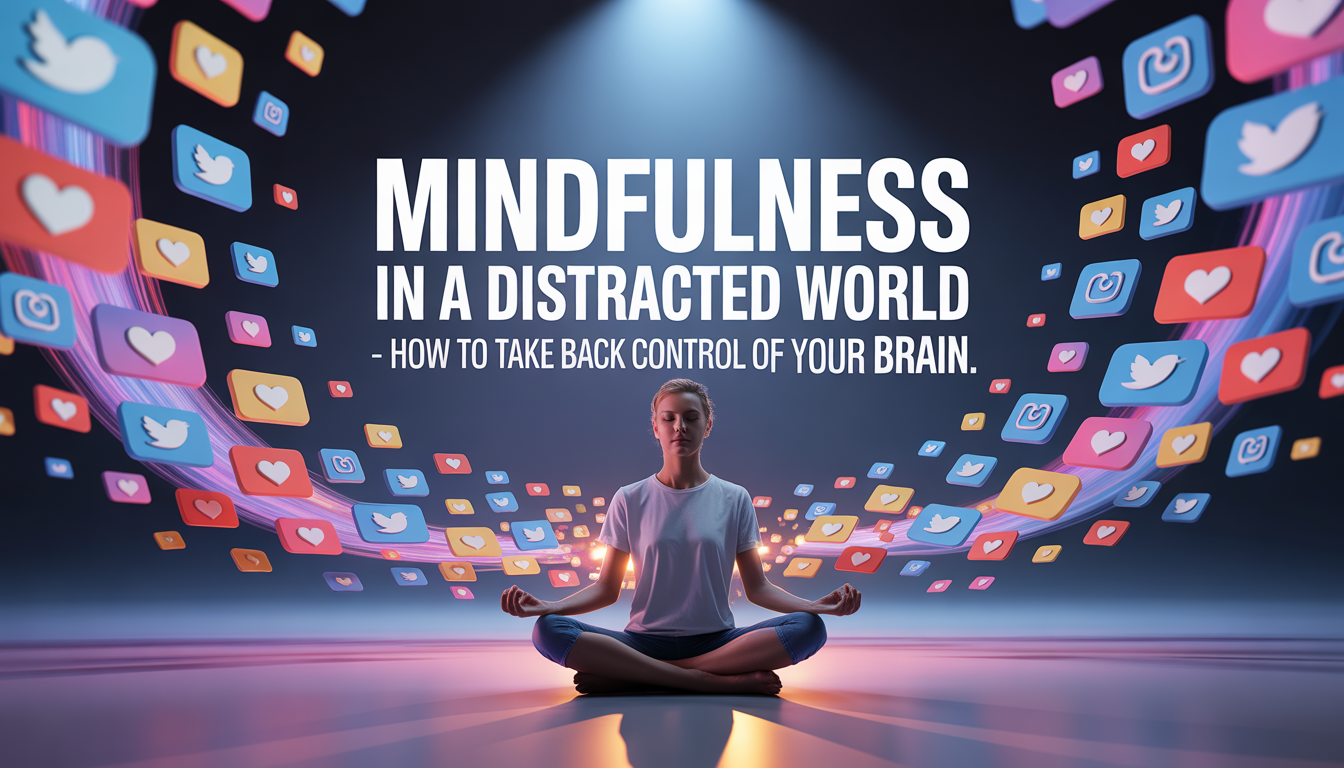
Do you ever feel like you have fifty browser tabs open inside your head and somewhere, one of them is playing music you cannot even locate? You sit down to work, open your laptop, and suddenly forget why you opened it in the first place. Your attention jumps from one thought to another. Past conversations replay. Future worries interrupt. Notifications pull at you. That is what a distracted brain feels like.
Mindfulness is the opposite of that chaos.
It is knowing where you are, how you are feeling, and what you are doing right now. In a world overloaded with content, reels, alerts, and endless scrolling, mindfulness is no longer a luxury. It is a survival skill. The good news is that mindfulness is not about becoming a monk or escaping to the mountains. It is about understanding your brain and learning how to guide it back to the present moment. Let us explore how you can train your mind to become calmer, sharper, and more aware.
Come Back to the Present Moment:
The first step toward mindfulness is surprisingly simple: pause and breathe. Take one deep breath. Slowly inhale. Slowly exhale. That breath is a signal to your brain. It says, “Stop. This is where I am.”
When you pause intentionally, even for five seconds, you interrupt autopilot mode. Most of the day, we operate automatically, scrolling without thinking, reacting without noticing, speaking without awareness. A conscious breath pulls you out of that loop.
Another powerful technique is writing. Take a pen and notebook and start scribbling whatever thoughts are in your head. Do not structure it. Do not edit it. Just move your hand while paying attention to your thoughts. That physical movement grounds you. Writing creates depth in the moment. It anchors your awareness.
Often, we think mindfulness means emptying the mind. But that is not accurate. In today’s world, the problem is not thinking too much; it is not processing enough. We consume massive amounts of information but rarely pause to digest it.
Mindfulness begins with observing your thoughts.
Are you replaying something from the past?
Are you worrying about something in the future?
Are you planning anxiously?
Simply observe. Do not fix yet. Observation comes first.
Understanding the Default Mode Network:
To truly understand mindfulness, we must understand the brain. Inside your brain is something called the Default Mode Network (DMN). This network activates when you are not focused on a task. It is responsible for daydreaming, mind wandering, imagining scenarios, and drifting between thoughts.
Whenever you are not actively paying attention, your brain switches to autopilot, and the DMN takes over. Imagine flying a kite. If you release the string, the kite drifts wherever the wind takes it. That is your mind under the influence of the Default Mode Network. Thoughts wander freely without direction.
Mindfulness is like grabbing the string again.
When you consciously bring your attention back to the present moment, you shift control from the Default Mode Network to the prefrontal cortex, the decision-making center of your brain. You are no longer drifting. You are steering.
The key insight here is that mind wandering is normal. It is not a flaw. But staying lost in it for long periods is what creates distraction and anxiety.
Strengthening the Prefrontal Cortex:
Your prefrontal cortex (PFC) is like the CEO of your brain.
It is responsible for:
- Decision-making
- Attention control
- Working memory
- Impulse regulation
When you see something distracting, it is your prefrontal cortex that decides whether to follow that distraction or stay focused. The stronger your PFC, the more mindful you can be.But how do you strengthen it?
Treat attention like a muscle.
Every time your mind drifts away from your task, and you gently bring it back, you are performing a “mental rep.” Just like lifting weights strengthens your biceps, redirecting attention strengthens your prefrontal cortex.
There is also an associated region called the anterior cingulate cortex that helps monitor attention and detect when your focus is slipping. Repeatedly bringing your awareness back strengthens this connection.
This is how willpower grows. One powerful exercise to train focus is a yogic practice called Trataka. In this technique, you fix your gaze on a single point, such as a candle flame, and try to reduce eye movement. The longer you can maintain steady focus, the stronger your attentional control becomes. It is simple, but incredibly effective.
Calming the Amygdala:
Another important part of the brain in mindfulness is the amygdala. The amygdala acts like your internal alarm system. Its job is to detect threats. If something feels dangerous, urgent, or alarming, the amygdala activates and shifts your attention immediately. This is useful in real danger. If there is a fire near you, your attention should shift. But in modern life, we face imaginary fires all day.
Social media constantly signals urgency:
- Breaking news
- Notifications
- Messages
- Alerts
Your brain perceives these as potential threats or urgent matters. As a result, your attention keeps flickering. Anxiety happens when the amygdala believes there is danger even when there is none. Mindfulness reduces unnecessary amygdala activation by reminding yourself: “There is no fire right now. I am safe. What I am doing in this moment is important.”
When you consciously reassure yourself, you calm the alarm system and regain control of your attention.
Three Daily Practices to Improve Mindfulness:
Understanding the brain is powerful, but daily practice is essential. Here are three practical tools you can apply immediately.
1. The Five-Second Pause:
Before starting any activity, pause for five seconds.
Take one breath and ask:
What am I doing?
How am I feeling?
This small check-in gives your prefrontal cortex context. It brings clarity to your actions. Instead of acting automatically, you act consciously. Five seconds may seem small, but practiced consistently, it transforms awareness.
2. Box Breathing:
Box breathing is a powerful technique used even by elite military units to improve calmness and focus.
Here is how it works:
Inhale for four seconds.
Hold your breath for four seconds.
Exhale for four seconds.
Hold again for four seconds.
Repeat this cycle for one minute. This breathing pattern shifts your body from a sympathetic (fight-or-flight) state to a parasympathetic (calm and rest) state. Your heart rate stabilizes. Your mind becomes clearer.
The beauty of box breathing is that you can practice it anywhere at work, while traveling, before a meeting, or before studying. One minute can reset your mental state.
3. Name Your Emotions:
There is a powerful phrase: “Name it to tame it.”
When you feel anxious, angry, or upset, try labeling the emotion.
Instead of saying, “I feel bad,” say:
“I feel anxious about tomorrow’s deadline.”
“I feel frustrated about that conversation.”
“I feel overwhelmed.”
When you name an emotion, you activate the language centers in your prefrontal cortex. This shifts processing away from the emotional limbic system and toward logical analysis. Giving words to emotions gives them structure. Once structured, they become manageable.
Journaling helps. Talking to a trusted friend helps. Even silently labeling the emotion helps. You will notice that once you name the feeling, it loses intensity.
Building a Mindful Life:
Mindfulness is not about suppressing thoughts. It is about guiding them. It is not about eliminating emotions. It is about understanding them. It is not about forcing concentration. It is about training the brain. In a world engineered for distraction, attention is your greatest asset. Every notification competes for it. Every piece of content pulls at it.
But with practice, you can reclaim it.
Pause.
Breathe.
Observe.
Bring your attention back.
Calm imaginary fires.
Name your emotions.
Each repetition strengthens your mental clarity. Over time, you will notice something powerful: your thoughts feel less chaotic. Your reactions feel slower and more intentional. Your focus improves. Your anxiety decreases. Mindfulness is not a destination. It is a daily practice, and every moment you choose awareness over autopilot, you strengthen the part of your brain that allows you to live fully right here, right now.
Conclusion:
In a world designed to capture and fragment our attention, mindfulness has become one of the most valuable skills we can develop. Distraction is no longer occasional—it is constant. Notifications, social media, endless content, and internal worries compete for control of our focus. Over time, this weakens our ability to stay present and increases stress and mental fatigue.
Mindfulness offers a way back. By understanding how the brain works, how the Default Mode Network causes mind wandering, how the prefrontal cortex controls attention, and how the amygdala triggers unnecessary alarms, we gain the power to intervene. Instead of being pulled by every thought or notification, we can consciously guide our attention.
The practices discussed, pausing for five seconds, box breathing, naming emotions, journaling, and attention training, are simple but powerful. They are not about escaping life’s challenges but about responding to them with awareness instead of reaction. Each time you bring your attention back to the present moment, you strengthen your mental control. Each time you calm imaginary threats, you reduce anxiety.
Mindfulness is not about perfection. Your mind will wander. That is normal. The power lies in returning. Over time, those small returns build clarity, resilience, and emotional stability. In a distracted world, the ability to focus is freedom. And mindfulness is how you reclaim it.
FAQs:
1. What is mindfulness in simple terms?
Mindfulness is the practice of paying full attention to the present moment your thoughts, emotions, and actions without judgment or distraction.
2. Why is my mind constantly distracted?
Modern life overstimulates the brain with constant notifications, content, and information. This activates the brain’s Default Mode Network and amygdala, causing frequent mind wandering and anxiety.
3. How long does it take to see benefits from mindfulness?
Some benefits, like calmness from breathing exercises, can be felt immediately. However, long-term improvements in focus and emotional control develop with consistent daily practice over weeks or months.
4. Can mindfulness reduce anxiety?
Yes. Mindfulness helps calm the amygdala (the brain’s alarm system) and strengthens the prefrontal cortex, which improves emotional regulation and reduces unnecessary stress responses.
5. Do I need meditation to practice mindfulness?
No. While meditation is helpful, mindfulness can be practiced anytime through conscious breathing, journaling, labeling emotions, or simply bringing attention back to the present moment during daily activities.